
Lobstersgram is a fast Telegram client for lobste.rs. It delivers the hottest Lobsters stories (articles that reached the home page) to the @lobstersgram channel with a clean telegra.ph reading view.
Bot: @lobstersgram_bot Post: https://mgaitan.github.io/en/posts/lobstersgram-cliente-rapido-lobsters/
The bot publishes to the channel; readers join the channel directly.
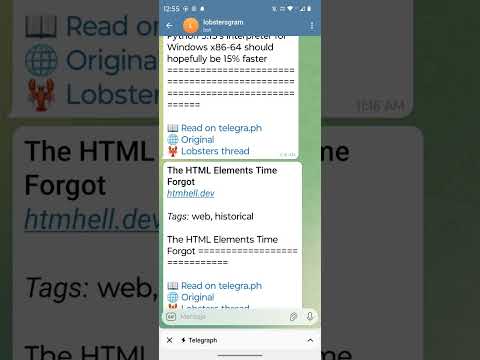
Demo:
- A GitHub Actions workflow runs on a schedule (cron).
- It fetches the Lobste.rs "hottest" RSS feed (home-page articles only).
- New items are detected via a local
state.jsonfile. - For each new item:
- The final article URL is resolved.
- The main content is extracted (Readability-style).
- A full article page is created on telegra.ph.
- A Telegram channel post is sent with:
- Title (bold)
- Source domain
- Link to the Telegraph page
- Link to the original article
- Link to the Lobsters discussion
- The processed item IDs are stored back into
state.json, which is committed automatically.
No callbacks, no pagination logic, no bot process running 24/7.
This workspace contains reusable packages used by the bot and a small web UI:
markdown-this: extracts web pages and supported special URLs as Markdown.md-to-telegraph: converts Markdown into Telegraph DOM nodes.markdown-web: FastAPI service with a web UI, URL endpoints, and bookmarklets for the two tools.
The web app is available at https://markdown.fastapicloud.dev/.
The md-to-telegraph package also provides an md-to-telegraph CLI for
publishing a Markdown file or stdin directly.
Each package has its own version and can be released independently from this workspace.
Run the web service locally with:
uv run --package markdown-web markdown-webIt exposes /md/{url} for Markdown and /t/{url} for Telegraph publishing.
Versions live in each package's own pyproject.toml. For example, to bump and
release markdown-this:
uv version --package markdown-this --bump patch
uv lock
git commit -am "Release markdown-this $(uv version --package markdown-this --short)"
git tag "markdown-this-v$(uv version --package markdown-this --short)"
git push origin main --tags
Create the GitHub release from that tag. The matching publishing workflow
verifies the package version, builds only that package, and publishes it to
PyPI. The reusable packages have separate Trusted Publisher workflows:
publish-md-to-telegraph.yml publishes md-to-telegraph, and
publish-markdown-this.yml publishes markdown-this. The lobstersgram
application is not published to PyPI yet.
Use the same commands with md-to-telegraph as the package name. The tag
format is <package>-v<version>.
Telegram bots cannot send hidden data or delegate pagination logic to the client. Any real “continue reading” flow would require a live bot handling callbacks.
Using telegra.ph gives us:
- Fast, clean, mobile-friendly reading
- No hosting or storage to maintain
- Instant article views
- A perfect fit for “read later” from Telegram
- Python 3.11+ (used by GitHub Actions)
- A Telegram bot token
- A Telegram channel where the bot can post
- A Telegraph access token
- Optional:
TELEGRAM_DEV_CHAT_IDto force sends only to your chat during local testing
The scheduled workflow publishes each new item to @lobstersgram. Readers join
the channel directly, so the bot does not need to maintain a recipient list.
All secrets are stored securely in GitHub Actions.
- Talk to
@BotFather - Create a new bot
- Save the bot token (
TELEGRAM_BOT_TOKEN)
Create a Telegram channel and add the bot as an administrator with the Post
Messages permission. Keep channel publishing restricted to administrators.
The current production channel is @lobstersgram.
Set the TELEGRAM_CHANNEL_ID GitHub Actions secret to @lobstersgram. Public
channel usernames can be used directly; private channels require their numeric
chat ID, usually starting with -100.
For local development, you can set TELEGRAM_DEV_CHAT_ID to force sends only
to your own chat.
Run once (locally or in a temporary script):
import requests

r = requests.post(
    "https://api.telegra.ph/createAccount",
    data={
        "short_name": "lobsters2tg",
        "author_name": "Your Name",
        "author_url": "https://lobste.rs/",
    },
)
print(r.json()["result"]["access_token"])
Save the resulting token.
In your repository:
Settings → Secrets and variables → Actions
Add the following secrets:
TELEGRAM_BOT_TOKENTELEGRAM_CHANNEL_IDTELEGRAPH_ACCESS_TOKEN
Local state file used to track already-processed items. Automatically committed by GitHub Actions.
Legacy subscribers file containing the chat_id values collected by the old
/start subscription mechanism. It is retained for the one-time migration
message and is still updated when reaction offsets are synchronized.
Scheduled GitHub Actions workflow that runs the pipeline.
Optional environment variables:
MAX_ITEMS_PER_RUN(default:5)REQUEST_TIMEOUT(default:20seconds)
These can be set directly in the workflow file.
You can trigger the pipeline manually from GitHub:
Actions → Lobsters to Telegram → Run workflow
Useful for testing or initial bootstrapping.
The scheduled workflow runs --sync-updates before publishing. This consumes
Telegram reaction updates so the existing bookmark export keeps working, but it
does not process /start or /unsubscribe commands.
Before channel publishing, readers sent /start to the bot and the workflow
stored their private or group chat_id values in subscribers.json. The
--read-messages option remains available for reading that legacy state, and
send-migration-message sends the prepared migration notice to those stored
chat IDs.
The migration workflow is manual and intentionally separate from the scheduled publisher. Run it once, after reviewing the message, from:
Actions → Migrate Telegram subscribers to channel → Run workflow
-
❌ No webhooks
-
❌ No callback queries
-
❌ No pagination inside Telegram
-
❌ No database
-
❌ No server
-
✅ Stateless execution
-
✅ Deterministic behavior
-
✅ Easy to maintain
-
✅ Easy to extend
- Attach the full article as an HTML or EPUB file
- Add other RSS sources
- Add basic keyword filtering
- Improve Telegraph HTML fidelity
- Mirror articles to a static archive
All without changing the serverless model.
MIT