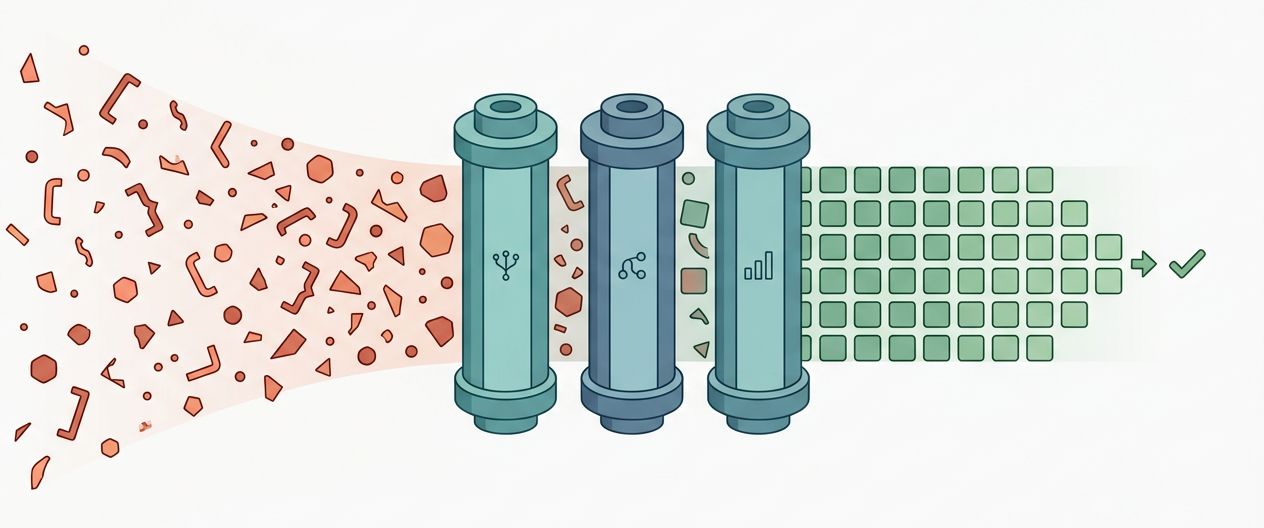
Strip noise from unit-test training data in seconds, not hours --- with rules where rules win, and an LLM only where it actually helps.


Quick start · Why this exists · Results · How it works · Skills usage · Paper
CleanTest-Agent takes a CSV of (focal_method, test_case) pairs --- the
canonical format used by Methods2Test, ATLAS, and most modern test-generation
benchmarks --- and removes the noisy ones, leaving only the samples that
actually teach a model how to write good tests.
It does this through three composable Agent Skills (each follows the
SKILL.md protocol, so they drop directly into CodeBuddy, Claude Code,
or Cursor):
- Syntax filter --- AST parsing with tree-sitter plus an Aho-Corasick automaton over a 21,954-pattern annotation dictionary.
- Relevance filter --- AST name matching with an opt-in 5-rule LLM reflection step for borderline indirect-testing cases.
- Coverage filter --- a JaCoCo-label scan by default, or a fine-tuned Qwen2.5-Coder-0.5B regression model when ground-truth labels are missing.
The whole pipeline processes 593,953 deduplicated Methods2Test samples in under three minutes on a laptop. A single-LLM-per-sample baseline takes ~20 days and still misses 78% of the noise.
The CleanTest paper (Zhang et al., FSE 2025 Distinguished Paper) showed that 43.5% of the Methods2Test corpus is noisy, and that filtering the noise improves downstream branch coverage by ~67% across CodeBERT, AthenaTest, StarCoder, and CodeLlama-7B on Defects4J. Their pipeline is effective but exists as one-shot scripts: hard to compose, hard to drop into a coding assistant, and missing a path for projects that have no JaCoCo labels.
This repository is a from-scratch reimplementation that splits the
pipeline into reusable skills, swaps the original CodeGPT coverage model
for a fine-tuned Qwen2.5-Coder-0.5B (~2.6x lower MAE), and adds an
optional Reflection step on the LLM relevance check. It is also the
source artefact for the companion 67-page paper under
report/.
- ...you train code models on Methods2Test, ATLAS, or any
(focal_method, test)corpus and want to remove noisy samples before training. - ...you want a rule-first pipeline (deterministic, free, fast) with an LLM only on the borderline cases.
- ...you want skills that drop into CodeBuddy / Claude Code / Cursor and trigger on natural language ("clean my test data", "check this test's relevance").
- ...you want to predict branch coverage for a
(focal, test)pair without running JaCoCo --- with held-out MAE of 0.031 from a 0.5B fine-tuned model.
If you want a dialogue-based "ask the LLM if this looks like a bad test" service, this is not that --- the whole point of this project is that you do not need to call the LLM 593,953 times.
Install from PyPI:
pip install cleantest-agentOr install from source for development (also installs the bundled sample dataset and tests):
git clone https://github.com/jimmy0717/cleantest-agent.git
cd cleantest-agent
pip install -e ".[dev]"

# Clean the bundled 5,000-row sample (no API needed):
cleantest --input_csv data/sample_5000.csv --output_dir output/

# Inspect the noise report:
cat output/noise_report.json
You should see something like:
{
  "total_input": 5000,
  "total_kept": 2389,
  "removed": {
    "unnecessary_annotation": 2122,
    "no_relevance":           201,
    "syntax_error":           107,
    "non_english_literal":     66,
    "ambiguous_data_type":     63,
    "missing_implementation":  12,
    "empty_exception":          5
  },
  "wall_clock_seconds": 1.4
}
To enable the optional LLM relevance check on borderline samples, set an
OpenAI-compatible endpoint and add --llm_enhance:
export OPENAI_API_KEY="your-key"
export OPENAI_BASE_URL="https://api.deepseek.com/v1"
cleantest --input_csv data/sample_5000.csv \
          --output_dir output/ \
--llm_enhance --reflectionWe ran the four pipelines below on a 500-sample stratified subset of Methods2Test (231 noise / 269 clean), with real DeepSeek-V4-Flash API calls for the LLM rows.
| Method | Precision | Recall | F1 | Time (500 samples) |
|---|---|---|---|---|
| Rule-based (ours) | 1.000 | 1.000 | 1.000 | 0.11 s |
| LLM zero-shot | 0.505 | 0.221 | 0.307 | 1,487 s |
| LLM few-shot | 0.534 | 0.303 | 0.387 | 1,642 s |
| Hybrid (rules + LLM borderline only) | 0.974 | 0.956 | 0.965 | < 60 s |
Why the LLM baselines fail: 78% of the noise in Methods2Test is "this
focal method is annotated with @ApiOperation / @SwaggerDefinition /
... and is therefore not useful for test-generation training". The LLM
has no way to recall the 21,954-pattern dictionary that defines this
class of noise; the Aho-Corasick automaton recalls it deterministically
in microseconds.
The full evaluation (RQ1-RQ4 + Filter 3 model-mode validation + a case
study + ablation study) is in report/main.tex
Section 7. Per-sample predictions are archived under
experiments/results/labeled_samples.csv.
The default Filter 3 reads condition_cover_rate straight from a
JaCoCo column. For label-free settings, we fine-tuned
Qwen2.5-Coder-0.5B on a stratified 80/10/10 split of LessIsMore-FSE2025
filter_train.csv (469,174 rows) on a single A800-SXM4-80 GB
(bf16, batch 64, max_seq 512, lr 3e-5 cosine, 2 epochs, ~3.3 h
wall-clock) and evaluated it on the held-out 46,921-sample test split:
| Metric | This work (Qwen2.5-Coder-0.5B) | CodeGPT (Zhang et al., FSE 2025) |
|---|---|---|
| MAE | 0.0309 | 0.0798 (~2.6x higher) |
| MSE | 0.0039 | 0.0105 (~2.7x higher) |
| RMSE | 0.0628 | -- |
| R-squared | 0.604 | -- |
| Pearson r | 0.778 | -- |
| Spearman rho | 0.848 | -- |
| F1 at tau = 0.10 | 0.857 | -- |
| F1 at tau = 0.15 | 0.912 | -- |
Raw artefacts (training_metrics.json, metrics.jsonl,
test_metrics.json, test_pred_a800.csv, test_threshold_sweep.json)
live under
experiments/results/coverage_run/.
The end-to-end notebook that produced them is
experiments/main-final.ipynb.
User / Coding Assistant
     |  natural-language trigger ("clean my test data")
     v
+-----------------------------------+
|  Orchestrator skill               |
|  (cleantest-pipeline)             |
+-----+----------+--------+---------+
      |          |        |
      v          v        v
+----------+ +-----------+ +--------------+
| Filter 1 | | Filter 2  | | Filter 3     |
| Syntax   | | Relevance | | Coverage     |
|          | |           | |              |
| AST +    | | Name      | | Qwen2.5-     |
| Aho-     | | match +   | | Coder-0.5B   |
| Corasick | | LLM       | | regression   |
| (21,954  | | fallback  | | (model mode) |
| patterns)| |           | |              |
+----+-----+ +-----+-----+ +------+-------+
     |             |              |
     +-------------+--------------+
                   |
                   v
         Clean dataset + noise report
Each filter is an independent Agent Skill; they share state through a
small NoiseReport accumulator and emit a single JSON + Markdown report
at the end.
| Original CleanTest scripts | ChatUniTest / pure-LLM workflows | Hand-rolled regex pipeline | CleanTest-Agent | |
|---|---|---|---|---|
| Faithful to the FSE 2025 paper's definitions | yes | partial | varies | yes |
| Composable into coding-assistant skills | no | partial | no | yes |
| Deterministic on the rule-decidable cases | yes | no | usually | yes |
| Aho-Corasick acceleration | no (linear scan) | n/a | rare | yes (~11.5x) |
| Optional Reflection on borderline LLM verdicts | no | no | no | yes |
| Filter 3 without JaCoCo labels | no | no | no | yes (Qwen 0.5B) |
| Cost on 593,953 samples | ~free | ~$35-58 (real-API) | ~free | ~$4.5 |
CleanTest-Agent ships four skills that follow the SKILL.md protocol and drop directly into CodeBuddy, Claude Code, Cursor, or any assistant that implements the protocol.
| Skill | What it does | Triggers on |
|---|---|---|
cleantest-pipeline |
full pipeline orchestration | "clean test data", "run cleantest" |
cleantest-syntax-filter |
syntax noise (AST + Aho-Corasick) | "check syntax noise" |
cleantest-relevance-filter |
test-focal relevance + reflection | "check test relevance" |
cleantest-coverage-filter |
branch coverage prediction | "predict coverage" |
Install all four into the local CodeBuddy skills directory:
make install # copies skills/* to ~/.codebuddy/skills/Then in your assistant, just ask in natural language:
"Help me clean this unit test training dataset under
~/datasets/methods2test_train.csvand write the report to~/datasets/cleaned/."
For the full distribution recipe (without cloning this repo), see
docs/skill-distribution-guide.md.
For a worked example of each skill, see
docs/code-assistant-guide.md.
cleantest-agent/
|-- cleantest_agent/            installable Python package
|   |-- pipeline.py             orchestrator (Aho-Corasick + 3 filters)
|   |-- parser_utils.py         tree-sitter AST utilities
|   |-- llm_client.py           OpenAI-compatible wrapper
|   |-- report_generator.py     JSON + Markdown reports
|   `-- data/noise_modifier_fm.txt   21,954-pattern dictionary
|-- skills/                     four SKILL.md skill bundles
|-- tests/                      36 pytest test cases
|-- experiments/                run_baselines.py + results/
|-- data/sample_5000.csv        bundled 5,000-row Methods2Test subset
|-- docs/                       user-facing guides
|-- report/                     LaTeX research paper (ACM acmlarge)
|-- .github/workflows/ci.yml    CI: Python 3.10/3.11/3.12 matrix
`-- pyproject.toml              package metadata + `cleantest` console script
Bug reports, feature requests, and pull requests are all welcome. The starting points are:
CONTRIBUTING.mdfor the development workflow,.github/ISSUE_TEMPLATE/for filing bug / feature / question issues,CODE_OF_CONDUCT.mdfor the (Contributor Covenant 2.1) baseline expectations.
If you fix a bug, the convention is: write a failing test first
(tests/), confirm it fails on main, then push the fix; see
tests/ for representative examples.
If you use CleanTest-Agent in academic work, please cite both the original CleanTest paper and this implementation:
@inproceedings{zhang2025cleantest,
  title     = {Less is More: On the Importance of Data Quality for Unit Test Generation},
  author    = {Zhang, Junwei and Hu, Xing and Gao, Shan and Xia, Xin and Lo, David and Li, Shanping},
  booktitle = {Proceedings of the 33rd ACM International Conference on the Foundations of Software Engineering (FSE)},
  year      = {2025},
  note      = {Distinguished Paper Award; arXiv:2502.14212}
}

@misc{yang2026cleantestagent,
  title  = {{CleanTest-Agent}: A Multi-Agent Skill-Orchestrated System for Unit Test Training Data Quality Assurance},
  author = {Yang, Yong},
  year   = {2026},
  howpublished = {\url{https://github.com/jimmy0717/cleantest-agent}}
}MIT. The bundled data/sample_5000.csv is a derivative
subset of Microsoft's MIT-licensed
Methods2Test dataset and is
redistributed under the same terms; see data/README.md
for the full attribution.
This repository was originally produced as the final-project artefact for Software Requirements Analysis and System Design at the School of Software, Beihang University. The deliverables map to the following entry points:
| Deliverable | Location |
|---|---|
| Research report (LaTeX, 67 pp.) | report/main.tex, bibliography report/references.bib, compiled PDF report/main.pdf |
| Slides (10 pages, 3-min talk) | ppt/slides.md (English), ppt/PPT大纲.md (Chinese outline) |
| Reproducible code | this repository |
| Test suite (36 cases) | tests/, make test |
| CI pipeline | .github/workflows/ci.yml |
| Real DeepSeek API experiments | experiments/run_baselines.py |
| Filter 3 model-mode training | experiments/main-final.ipynb (end-to-end), skills/cleantest-coverage-filter/scripts_paddle/ |
| Code-assistant skill bundles | skills/ |
| Skill installation guide | docs/skill-distribution-guide.md |
| Code-assistant usage guide | docs/code-assistant-guide.md |
| Baidu AI Studio training guide | docs/training-on-baidu-aistudio.md |