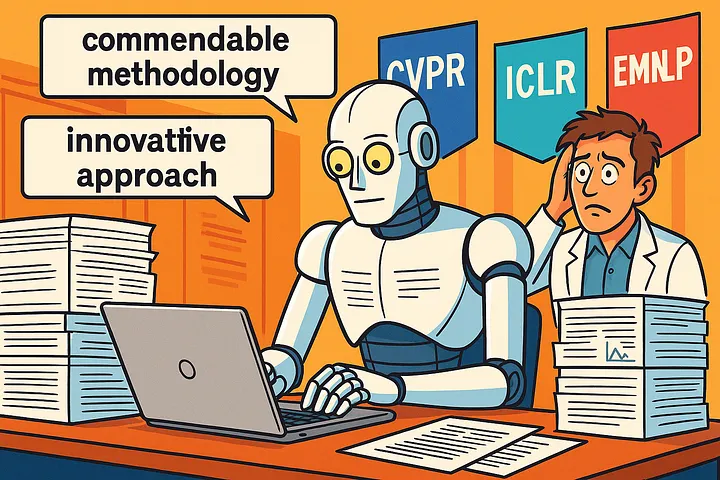
Pre-review to Peer review | Pitfalls of Automating Reviews using Large Language Models
Large Language Models are versatile general-task solvers, and their capabilities can truly assist people with scholarly peer review as
- Using Language models in scholarly peer review seems comes with significant risks surrounding safety, research integrity and validity of the review.
- Inevitably people utilize LLMs as pre-review agents if not fully autonomous peer-review agents.
- Lack of a systematic evaluation of LLMs generating reviews across science disciplines misses the mark on and assessing the alignment/misalignment question.
- Part 1: Assess and review the ideas presented in a scientific article just using the abstract
- TuluV3
- Nemotron-49b-1.5
- Qwen3-32b
- Llama3.3-70b
- Gemma3-27b
- NOTE : Models that are open-weight, SOTA, and fit the context window (> 32k) of full-text were the reason for selection
- Part 2: Assess and review the ideas and fully review the scientific article using the full-text
- Part A: Using Dense Models
- TuluV3
- Nemotron-49b-1.5
- Qwen3-32b
- Llama3.3-70b
- Gemma3-27b
- Part B: Using Reasoning Models
- Distill R1-llama-70b
- Qwen/Qwen3-Next-80B-A3B-Thinking
- GPT-OSS-20b
- GPT-OSS-120b
- NOTE : Models that are open-weight, SOTA, and fit the context window (> 32k) of full-text were the reason for selection
- Part A: Using Dense Models
- Part 3: Create Post publications outcomes dataset that captures.
- Part 4: Correlations and statistical analysis of LLM generated peer-review scores against post-publication outcomes like C5 (citations up-until 5 years), Novelty, Disruption and Hit papers.
- Ablation 1: Effect of instructions in Dense over alignment of review scores.
- Ablation 2: Effect of reasoning strength in arguing merits of peer review for reasoning models.
- Discussion: Alignment vs Misalignment of ground truth, a case study.

More about the data can be found here.
NOTE: The datasets are available as parquet files on Google drive, and they can be found here.
├── LICENSE
├── README.md
├── data
│   ├── README.md
│   ├── __init__.py
│   └── media
│       ├── review_idea_distribution.png
│       ├── review_joint_distribution.png
│       └── review_paper_distribution.png
└── src
    ├── __init__.py
    ├── icl.py
    ├── prompts.py
└── schema.pyInstall uv
curl -LsSf https://astral.sh/uv/install.sh | shor via pip
pip install uvHave the following packages installed to run LMRSD
uv pip install torch --index-url https://download.pytorch.org/whl/cu128
uv pip install bitsandbytes
uv pip install git+https://github.com/huggingface/transformers
uv pip install deepspeed
uv pip install sentencepiece
uv pip install vllm tiktoken outlines trl openai polars peft tqdm pydantic google-genai matplotlib scikit-learn ninja bs4Thanks to a public OpenReview reviews dataset hosted on Hugging Face, which was crucial for the dataset, experiments, and methodology of the paper.
Anonymous authors (for double-blind review).