




The only test reporter you'll ever need. Playwright · Cypress · Jest · Vitest · Puppeteer · Selenium · WebdriverIO — one package, zero config, beautiful results.
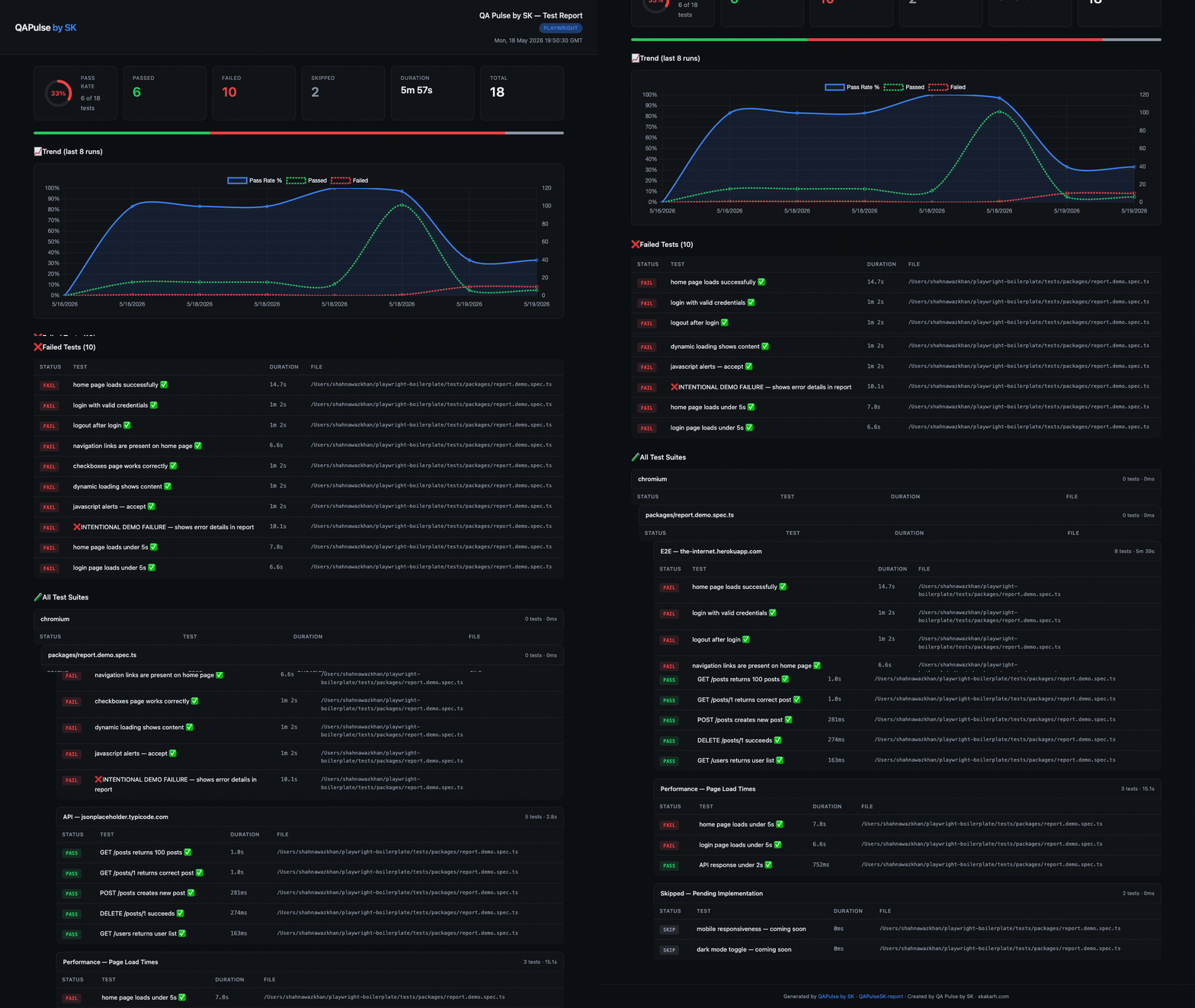
Most teams install 4–5 separate reporter packages — one per framework, one for Slack, one for AI, one for trends. We ship everything in one.
| Feature | QAPulseSK-report | Others |
|---|---|---|
| 7 test runners in one package | ✅ | ❌ 1 per package |
| Screenshots on failure (all runners) | ✅ | Partial |
| Failure clustering (dedup similar errors) | ✅ | ❌ |
| 7 built-in themes | ✅ | ❌ |
| Trend + sparkline + histogram + timeline | ✅ | Paid |
| Diff vs previous run + failure state badges | ✅ | ❌ |
| Auto git/CI metadata (branch, commit, PR link) | ✅ | ❌ |
| AI failure analysis | ✅ Opt-in, your key | ❌ |
| Slack + Teams + Discord webhooks | ✅ Built-in, rich | Basic |
| JSON export | ✅ | ❌ |
| Zero cost to use | ✅ Always | Often paid |
npm install qapulsesk-report --save-devNode 18+ required.
// playwright.config.ts
import { defineConfig } from '@playwright/test';
import path from 'path';

export default defineConfig({
  use: { screenshot: 'only-on-failure' },   // <- enables screenshot capture
  reporter: [
    ['list'],
    [
      path.resolve(__dirname, 'node_modules/qapulsesk-report/dist/adapters/playwright.js'),
      {
        outputDir:   'qapulse-report',
        reportTitle: 'My E2E Tests',
        history:     { enabled: true },
      }
    ],
  ],
});
Playwright screenshots ship natively — no extra hooks needed.
// cypress.config.ts
import { defineConfig } from 'cypress';

export default defineConfig({
  reporter: 'node_modules/qapulsesk-report/dist/adapters/cypress.js',
  reporterOptions: {
    outputDir:   'qapulse-report',
    reportTitle: 'My Cypress Tests',
    history:     { enabled: true },
  },
  e2e: {
    screenshotOnRunFailure: true,   // <- default true, keep it on
    setupNodeEvents(on, config) { return config; }
  }
});// jest.config.js
module.exports = {
reporters: [
'default',
['qapulsesk-report/jest', {
outputDir: 'qapulse-report',
reportTitle: 'My Jest Tests',
history: { enabled: true },
}],
],
};For screenshots (Jest + Puppeteer):
// jest.setup.js
const { attachScreenshot } = require('qapulsesk-report');

afterEach(async () => {
  const state = expect.getState();
  if (state.assertionCalls > 0 && state.numPassingAsserts < state.assertionCalls) {
    const p = `/tmp/${Date.now()}.png`;
    await page.screenshot({ path: p });
    attachScreenshot(state.currentTestName, p);
  }
});// vitest.config.ts
import { defineConfig } from 'vitest/config';
import { QAPulseVitestReporter } from 'qapulsesk-report/vitest';
export default defineConfig({
test: {
reporters: [
'verbose',
new QAPulseVitestReporter({
outputDir: 'qapulse-report',
reportTitle: 'My Vitest Tests',
history: { enabled: true },
}),
],
},
});Screenshots via attachScreenshot (same as Jest above).
import puppeteer from 'puppeteer';
import { QAPulsePuppeteerReporter } from 'qapulsesk-report/puppeteer';

const reporter = new QAPulsePuppeteerReporter({
  outputDir:   'qapulse-report',
  reportTitle: 'Smoke Suite',
  history:     { enabled: true },
});

const browser = await puppeteer.launch();
const page = await browser.newPage();

reporter.startTest('Home page loads', { suite: 'Public' });
try {
  await page.goto('https://example.com');
  await page.waitForSelector('h1');
  reporter.endTest('passed');
} catch (err) {
  const shot = `/tmp/${Date.now()}.png`;
  await page.screenshot({ path: shot });
  reporter.endTest('failed', { error: err, screenshotPath: shot });
}

await browser.close();
await reporter.finish();import { Builder } from 'selenium-webdriver';
import { QAPulseSeleniumReporter } from 'qapulsesk-report/selenium';
import * as fs from 'fs';
const reporter = new QAPulseSeleniumReporter({ reportTitle: 'Selenium Suite' });
const driver = await new Builder().forBrowser('chrome').build();
reporter.startTest('Login works', { suite: 'Auth' });
try {
await driver.get('https://example.com/login');
reporter.endTest('passed');
} catch (err) {
const shot = await driver.takeScreenshot();
const p = `/tmp/${Date.now()}.png`;
fs.writeFileSync(p, shot, 'base64');
reporter.endTest('failed', { error: err, screenshotPath: p });
}
await driver.quit();
await reporter.finish();// wdio.conf.ts
import QAPulseWDIOReporter from 'qapulsesk-report/webdriverio';
export const config = {
reporters: [
[QAPulseWDIOReporter, {
outputDir: 'qapulse-report',
reportTitle: 'WDIO Suite',
history: { enabled: true },
}],
],
};For screenshots, add an afterTest hook that calls attachScreenshot(test.fullTitle, path).
Every report is a single portable HTML file with:
- Metadata bar — auto-detected git branch, commit, author, PR link, CI job link
- Diff banner —
+N new · −N recovered · N still failingvs the previous run - Pass rate ring + sparkline — at-a-glance status and trajectory across runs
- Stats cards — passed / failed / skipped / duration / total
- 🧩 Failure clusters — similar errors grouped by normalized signature
- 🔍 Insights
- Suite health matrix (heatmap of per-suite pass rate)
- Duration distribution histogram
- Top 10 slowest tests
- Per-suite execution timeline (colored strip)
- 📈 Trend chart — pass rate + passed/failed counts over your last N runs
- ❌ Failed tests — expandable rows with error, stack, screenshots, AI analysis, and failure-state badge (🆕 new / 💥 regression / 🔁 recurring)
- 🧪 All test suites — every test with its status
Plus a companion qapulse-report.json for downstream tools.
Seven built-in presets — set with a single line:
theme: { name: 'dracula' }| Name | Look |
|---|---|
qapulse-dark (default) |
Deep blue-black, blue accent |
qapulse-light |
Warm off-white, blue accent |
github-dark |
GitHub UI dark palette |
github-light |
GitHub UI light palette |
dracula |
Dracula editor theme |
solarized-light |
Solarized parchment |
minimal |
Pure monochrome |
Override any color inline:
theme: { name: 'qapulse-dark', primaryColor: '#00ffcc' }Handled per runner:
| Runner | How screenshots arrive |
|---|---|
| Playwright | Native — reads result.attachments[] |
| Cypress | Native — reads run.screenshots[] by testId |
| WebdriverIO | Via attachScreenshot() in afterTest hook |
| Puppeteer | Pass screenshotPath to endTest() |
| Selenium | Same as Puppeteer |
| Jest / Vitest | Via attachScreenshot() in afterEach |
The collector inlines small images (≤200 KB by default) as base64 data URIs so the report stays a single portable file. Larger images are copied to <outputDir>/screenshots/. Click any thumbnail for a full-screen lightbox (ESC to close).
Config:
screenshots: {
  enabled:            true,   // default
  onFailure:          true,   // default
  onPass:             false,  // default
  inlineThresholdKb:  200,    // default
  outputSubdir:       'screenshots',
}Failures with similar normalized error signatures collapse into a single card with a ×N badge. Under the hood:
- Timestamps, UUIDs, hex, absolute paths, and integers are normalized out of the message + top stack frame
- Failed tests are bucketed by signature
- When AI is enabled, analysis runs once per cluster (representative test), not once per test — massive token savings
Example: three timeout tests with different test names but the same error string produce one ×3 cluster with a single AI-generated root cause + fix.
We never call any AI service by default. Bring your own key.
ai: {
  enabled: true,
  provider: 'anthropic',                        // or 'openai' | 'gemini'
  apiKey:   process.env.ANTHROPIC_API_KEY,
  model:    'claude-3-5-haiku-20241022',        // provider default used if omitted
  maxFailuresToAnalyze: 10,
}
Per cluster you get:
- Summary — plain English
- Root cause — what actually caused it
- Suggestion — concrete fix
- Confidence — high / medium / low
Getting a key:
- Anthropic → API keys → Create →
ANTHROPIC_API_KEY=sk-ant-... - OpenAI →
OPENAI_API_KEY=... - Google Gemini →
GEMINI_API_KEY=...
All three platforms get rich context, not just pass/fail counts:
- Emoji + title with your
reportTitle - Framework, pass rate, passed/failed/skipped, duration
- Branch, commit hash, commit message (auto-detected)
+N new · −N recovered · N still failingvs previous run- Top 3 failure clusters with
×Ncounts - Top N failed test titles (configurable)
- Clickable buttons: 📊 View report, 🔀 PR #123, ⚙️ CI job
- Optional
@mentionon regressions
webhooks: {
  slack:   process.env.SLACK_WEBHOOK_URL,
  teams:   process.env.TEAMS_WEBHOOK_URL,
  discord: process.env.DISCORD_WEBHOOK_URL,

  reportUrl:          'https://reports.example.com/latest',
  notifyOnFailOnly:   true,
  maxFailedInCard:    5,
  mentionOnRegression: 'U0123ABC',   // Slack user or group id
}
Setup, per platform:
- Slack — App Directory → Incoming Webhooks → add to a channel → copy URL
- Teams — Channel → Connectors → Incoming Webhook → configure → copy URL
- Discord — Channel settings → Integrations → Webhooks → New → copy URL
Enable history and the report gains a pass-rate sparkline, a trend line chart, failure-state badges (🆕 / 💥 / 🔁), and a diff banner comparing to the previous run.
history: {
  enabled:     true,
  maxRuns:     20,                          // default
  historyFile: '.qapulse-history.json',     // auto-created inside outputDir
}
Each stored run includes per-test outcomes, so QAPulseSK-report can tell whether a currently-failing test is:
- 🆕 new — never seen before
- 💥 regression — passed last time, fails now
- 🔁 recurring (×N) — failed for the last N runs in a row
Every report auto-detects and displays:
- Git: branch, short commit, commit message, author, tag
- CI: provider, job URL, PR number + link
Detected providers: GitHub Actions, GitLab CI, CircleCI, Jenkins, Bitbucket Pipelines, and generic CI=true fallback.
Disable entirely with disableAutoMetadata: true, or override:
// Attach freely — user metadata always wins over auto-detected
run.metadata = { git: { branch: 'my-override' }, custom: { anything: 'ok' } };Alongside qapulse-report.html you get qapulse-report.json with the full normalized TestRun, clusters, diff, and failure states. Great for:
- Consumption by other tools (SAT, dashboards, CI gates)
- Post-processing in Node/Python
- Long-term storage / analytics
Disable with emitJson: false.
{
  outputDir?:             string;     // default: 'qapulse-report'
  reportTitle?:           string;     // default: 'QAPulseSK Test Report'
  openAfterGeneration?:   boolean;    // default: false
  logo?:                  string;     // optional logo image path or URL

  theme?: {
    name?:               'qapulse-dark' | 'qapulse-light' | 'github-dark' |
                         'github-light' | 'dracula' | 'solarized-light' | 'minimal';
    primaryColor?:       string;
    backgroundColor?:    string;
    cardColor?:          string;
  };

  ai?: {
    enabled:               boolean;
    provider?:             'anthropic' | 'openai' | 'gemini';
    apiKey?:               string;
    model?:                string;
    maxFailuresToAnalyze?: number;  // default: 10
  };

  webhooks?: {
    slack?:                string;
    teams?:                string;
    discord?:              string;
    custom?:               Array<{ url: string; headers?: Record<string,string>; template?: (run) => object }>;
    notifyOnFailOnly?:     boolean;
    reportUrl?:            string;
    mentionOnRegression?:  string;
    mentionOnNewFailures?: boolean;
    maxFailedInCard?:      number;  // default: 5
  };

  history?: {
    enabled:      boolean;
    historyFile?: string;
    maxRuns?:     number;  // default: 20
  };

  screenshots?: {
    enabled?:            boolean;  // default: true
    onFailure?:          boolean;  // default: true
    onPass?:             boolean;  // default: false
    inlineThresholdKb?:  number;   // default: 200
    outputSubdir?:       string;   // default: 'screenshots'
  };

  emitJson?:             boolean;  // default: true
  disableAutoMetadata?:  boolean;  // default: false
}The with-packages branch of the Playwright boilerplate wires qapulsesk-report and ships a dedicated demo spec:
git clone -b with-packages https://github.com/QAPulse-by-SK/playwright-boilerplate.git
cd playwright-boilerplate && npm install && npx playwright install

npx playwright test tests/packages/report.demo.spec.ts --project=chromium
open qapulse-report/qapulse-report.html
Live demo report: qapulse-report-sk.surge.sh
- Rich Slack / Teams / Discord webhooks: failed test list, cluster summary, diff vs previous run, git/PR link, "View report" button, optional @-mention on regressions
reportUrlconfig for clickable button in cards- Live-fire webhook smoke test (
npm run smoke:webhooks)
- 🧩 Failure clustering — local error-signature bucketing; AI runs once per cluster instead of per test
- 🔍 Insights section — suite health matrix, duration histogram, top 10 slowest, per-suite execution timeline (all zero-dep SVG)
- Diff vs previous run —
+N new / −N recovered / N still failingbanner - Failure-state badges — 🆕 new / 💥 regression / 🔁 recurring (×N) per failing test
- Auto git/CI metadata bar — branch, commit, author, PR + job links; supports GitHub Actions / GitLab / CircleCI / Jenkins / Bitbucket
- JSON export —
qapulse-report.jsonalongside HTML - Sparkline in pass-rate card
- Fix: history save now ensures output dir exists
- 7 built-in themes — qapulse-dark, qapulse-light, github-dark, github-light, dracula, solarized-light, minimal
- Legacy color overrides still work
- Screenshots on failure across all runners (inline base64 ≤200 KB, else copied) with click-to-zoom lightbox
- 3 new runners: Puppeteer, Selenium, WebdriverIO — 4 → 7
- New
attachScreenshot(fullTestName, path)registry for runner-agnostic capture - Extracted shared
orchestratorfrom adapter pipelines
- Initial releases: Playwright, Cypress, Jest, Vitest adapters
- Dark-theme HTML report
- Slack / Teams webhooks
- AI failure analysis
- Trend history
| Package | Description |
|---|---|
| qapulsesk-assert | Fuzzy assertions, schema validation, AI-powered checks |
| qapulsesk-gen | HAR → tests, recordings → tests, plain English → tests |
| qapulsesk-healer | Self-healing locators for Playwright/Selenium |
MIT © QA Pulse by SK
Created by QA Pulse by SK · skakarh.com
| 🌐 Website | www.skakarh.com |
| 📦 All Open Source Products | skakarh.com/products |
| ✍️ QA Automation Blog | skakarh.com/blog |
| 🛠️ QA Consulting Services | skakarh.com/services |
| 🏢 GitHub Organisation | github.com/QAPulse-by-SK |
| 🎭 Playwright Boilerplate | github.com/QAPulse-by-SK/playwright-boilerplate |
| 🌲 Cypress Boilerplate | github.com/QAPulse-by-SK/cypress-boilerplate |
| 🐍 Selenium Boilerplate | github.com/QAPulse-by-SK/selenium-boilerplate |
| 📦 qapulsesk-assert | npmjs.com/package/qapulsesk-assert |
| 🤖 qapulsesk-gen | npmjs.com/package/qapulsesk-gen |