


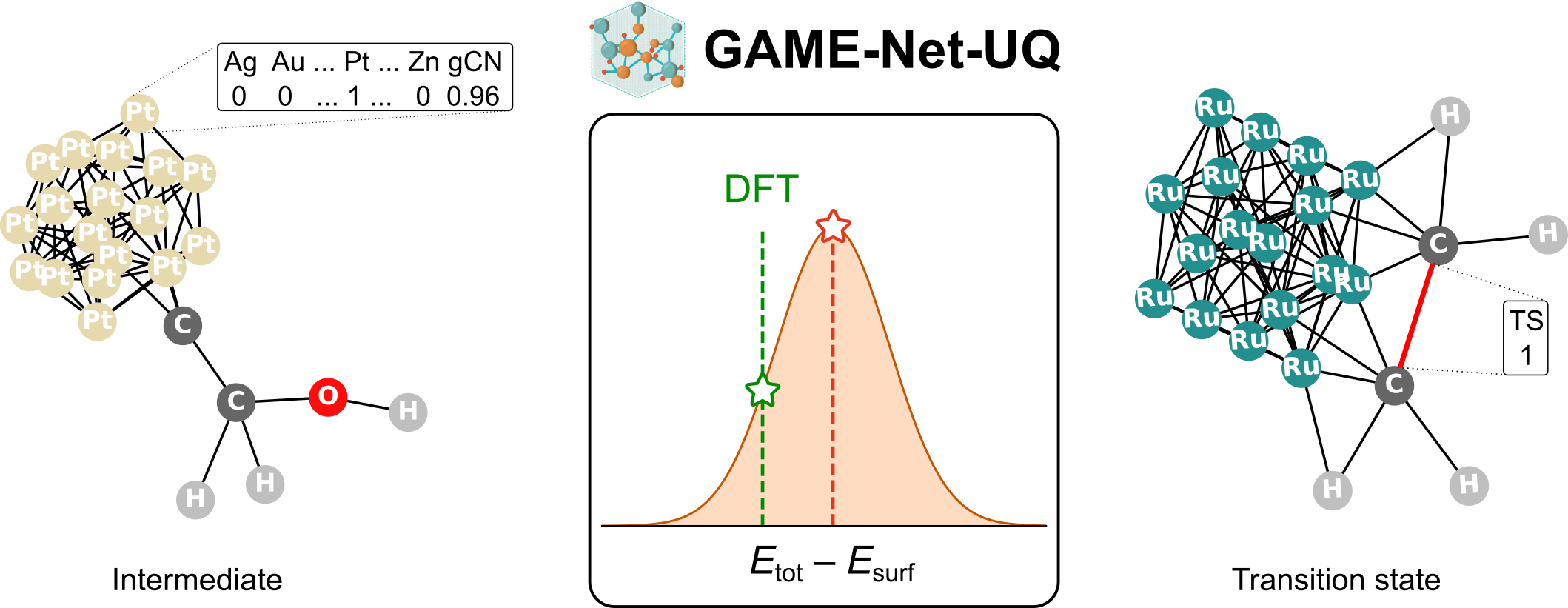
This repository contains the Python code used to train and evaluate GAME-Net-UQ, a graph neural network with uncertainty quantification (UQ) for predicting the DFT energy of relaxed species and transition states adsorbed on metal surfaces.
pip install gamenet-uqThe main dependencies of the repo can be found in pyproject.toml
The datasets used to develop GAME-Net-UQ can be found in the Zenodo repository https://doi.org/10.5281/zenodo.17977395.
- The ASE database (212 MB) containing all relaxed DFT structures and transition states is located at
gamenetuq_results/ASE_database/all.db. - The final, clean graph dataset (102 MB) in PyG format is located at
gamenetuq_results/PyG_graph_database/all_scaled_energy_025_125_2_False_False_False_True_False. The graph dataset can be recreated from the ASE database with the gen_dataset.py script.
To train the model, run the script train_mve.py. The input template file provides an explanation for each entry required in the training configuration file.
python train_mve.py -i input.toml -o output_dirnameThe final pretrained model can be employed with CARE (link).
The code is released under the MIT license.
Morandi, S., Loveday, O., Renningholtz, T. et al. An end-to-end framework for reactivity in heterogeneous catalysis. Nat. Chem. Eng. (2026). https://doi.org/10.1038/s44286-026-00361-8