See REQUIRED_VERL.txt for the upstream repository, install mode (rolling main, pinned release tag, or pinned git commit), and copy-pastable pip / git instructions where they exist.
This recipe extends the GKD (On-Policy Knowledge Distillation) recipe with Ascend NPU support and FSDP/FSDP2 backend support, enabling knowledge distillation training on Huawei Ascend NPUs and providing an alternative to the Megatron-based training backend.
On-policy knowledge distillation (KD) trains a student policy to imitate a stronger teacher using samples drawn from the student's current policy. For each on-policy rollout the teacher returns soft, top-k token distributions and the student is optimized with a token-wise sparse KL objective that focuses learning on the teacher's high-probability modes. Because training examples come from the student's own state distribution, KD reduces distributional mismatch relative to off-policy distillation or supervised fine-tuning (SFT), improving stability and sample efficiency. Compared with reinforcement learning, KD avoids high-variance reward-based optimization and complex reward design by providing dense, informative per-token targets, which typically yields faster convergence and simpler scaling.
Built on verl's Ray-based single-controller components, we initially assembled a strictly on-policy KD pipeline where rollout generation, teacher knowledge acquisition, and policy optimization ran in lockstep. In practice, this synchronous design proved highly inefficient: the three stages had to wait for one another, creating pipeline bubbles and underutilized GPUs. To address this, we extend the asynchronous schedulers introduced by the One-Step-Off Policy pipeline to overlap these phases. This overlap preserves the same distillation objective while trading some strict on-policy guarantees for substantial gains in end-to-end throughput and hardware utilization.
This recipe is a direct fork of the original recipe/gkd with the following additions and modifications:
To run GKD training on Ascend NPUs, the following key adaptations were made:
- Device auto-detection:
main_gkd.pycallsauto_set_ascend_device_name(config)to automatically setconfig.trainer.device = npuwhen running on Ascend hardware, so no manual config changes are needed. - HCCL communication backend:
distributed_util.pyreplaces NCCL with HCCL (viavllm_ascend.distributed.device_communicators.pyhccl) for weight synchronization between actor and rollout workers on NPU. - NPU-aware weight sync group creation:
ray_trainer.pyandmegatron_workers.pyuse a separate weight-sync group creation path for NPU, bypassing the Ray collective group approach (which relies on NCCL) and instead using a direct IP/port-based stateless process group. - Device name propagation: All worker modules use
get_device_name()(fromverl.utils.device) instead of hardcoded"cuda", ensuring tensors and autocast operations target the correct device.
The original GKD recipe only supports an embedded vLLM engine as the teacher backend, which requires loading the teacher model into a worker process. This recipe adds a vLLM API backend (vllm_api) that connects to an existing vLLM serve API server via its OpenAI-compatible completions API, instead of embedding the vLLM engine in the worker:
teacher/vllm_api_backend.py: ImplementsVLLMAPIBackendclass that connects to an externalvllm serveinstance, retrieves top-k logprobs through the completions API, and handles batch splitting to avoid OOM on the vLLM server side.teacher/start_server_vllm_api.sh: Startup script for the API backend mode — first waits for the vLLM serve API to be ready, then launches the proxy and worker with--backend vllm_api.teacher/worker.py: Extended to support--backend vllm_apiwith--api-baseand--serve-modelarguments alongside the original--backend vllm_engine.
This is particularly useful on Ascend NPU where vLLM-Ascend is deployed as a standalone inference service, or when the teacher model is already running as a shared API server that multiple training jobs can consume simultaneously.
The original GKD recipe only supports the Megatron training backend. This recipe adds a full FSDP/FSDP2 backend alongside Megatron, enabling users who prefer FSDP's simpler deployment model or who are working with models not yet supported by Megatron:
fsdp_workers.py: ImplementsFSDPOnPolicyDistillActorWorkerandFSDPOnPolicyDistillRolloutWorker, reusing the disaggregated weight-sync path fromrecipe.one_step_off_policy.fsdp_workersand overridingupdate_actor/async_generate_sequencesfor the KD objective.fsdp_kl_loss.py: FSDP-adapted version of the KL distillation loss. Since FSDP does not shard the vocab dimension across tensor-parallel ranks, the logits tensor on every rank already contains the full vocab dimension, allowing standard softmax / KL computation directly (no vocab-parallel cross-entropy needed).- Dual config files:
config/on_policy_distill_trainer.yaml(FSDP) andconfig/on_policy_distill_megatron_trainer.yaml(Megatron) provide separate Hydra configurations for each backend. - Backend selection:
main_gkd.py'screate_role_worker_mapping()dispatches to the correct worker classes based onactor_rollout_ref.actor.strategy(megatron,fsdp, orfsdp2).
This recipe centers on on-policy knowledge distillation: the student policy learns from a stronger teacher on samples generated by the current policy (on-policy). For each input prompt, the student (actor) generates responses; the teacher provides top-k token distributions, and the student is trained to match them token-wise.
Core components:
- Teacher signal: top-k log-probabilities and token indices per valid token position.
- Student objective: sparse, token-level KL divergence between student logits and teacher top-k distribution.
Objective: encourage student probabilities
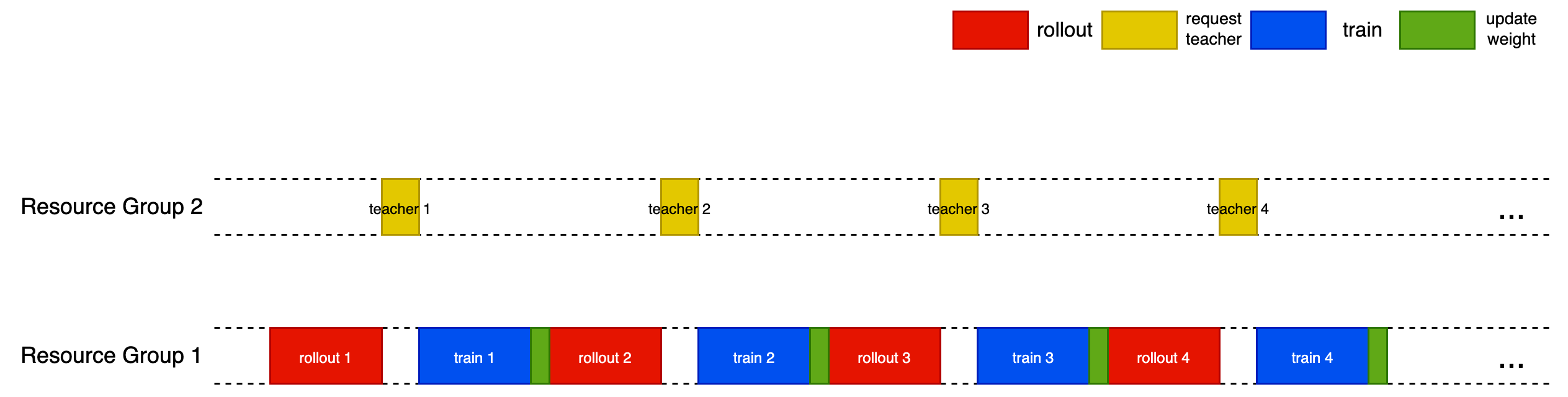
The native (serial) on-policy distillation process is shown in the figure below.
This recipe supports optional schedulers that overlap generation, teacher querying, and updates to improve throughput without changing the distillation objective.
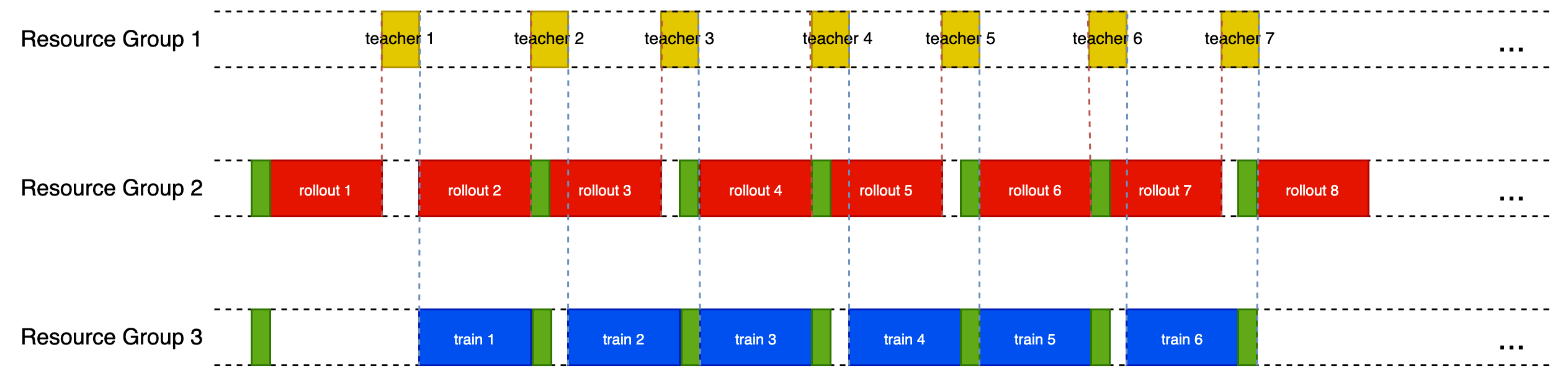
- Warm-up: 2 steps.
- Overlap pattern: rollout while actor update; weight sync while teacher retrieving.
- Timing keys:
sync_rollout_weights,wait_prev_gen,wait_prev_teacher.
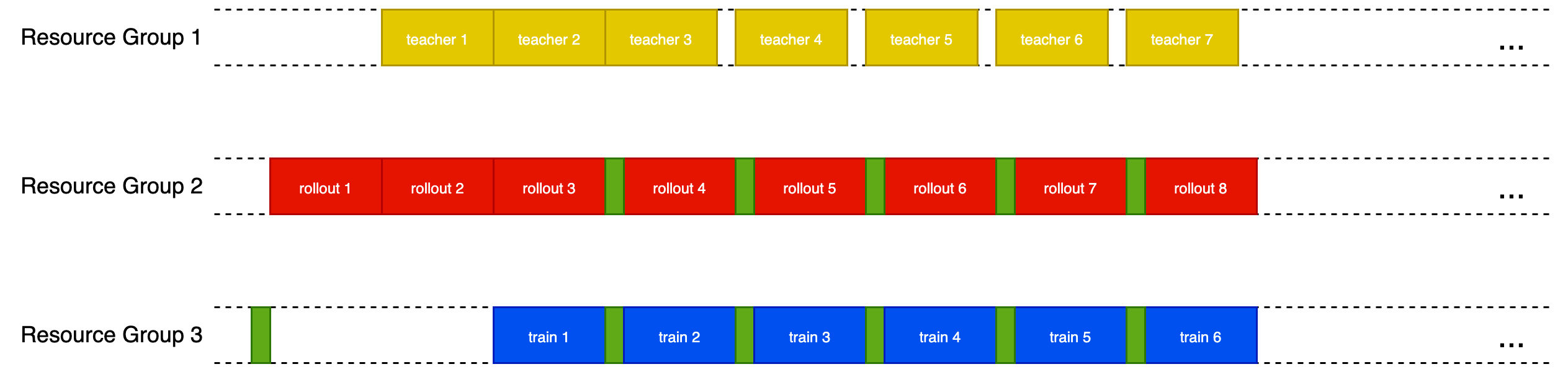
- Warm-up: 3 steps.
- Overlap pattern: rollout, actor update while teacher retrieving; interleave weight sync.
- Timing keys:
sync_rollout_weights,max(wait_prev_gen, wait_prev_prev_teacher).
Tip: Use two_step_off when teacher takes much more time than sync; one_step_off for simpler overlapping.
We initially followed the weight synchronization path from the One-Step-Off-Policy recipe (Ray collective broadcast across all actor and rollout ranks, plus Megatron-side allgather of parameter shards). In practice this became the dominant bottleneck, so we made three changes:
- Batch-and-bulk load on the rollout side: instead of streaming tensors one-by-one, we stage a bundle of parameter tensors and issue a single batched load into the rollout engine.
- Batch-and-bulk broadcast between the actor and rollout: instead of streaming tensors one-by-one, we stage a bundle of parameter tensors and issue a single batched broadcast between the actor and rollout workers.
- Replace allgather with gather-to-root in Megatron: parameter shards are gathered to actor rank 0, and that root serves as the single source for broadcasting to rollout ranks.
Driver (TaskRunner)
  ├─ Initialize Ray, tokenizer, datasets, worker groups
  ├─ Build ResourcePoolManager (actor vs rollout GPU/NPU layouts)
  ├─ Trainer.fit()
      ├─ init_workers(): build actor + rollout groups, broadcast weight metadata,
      │   create weight-sync group (NCCL on GPU, HCCL on NPU)
      ├─ continuous_iterator(): epochs → batches
      ├─ scheduler (see Section 4)
        • _async_gen_next_batch(): optional weight sync + non-blocking rollout
        • _async_get_teacher_knowledge(): submit teacher requests, store future
        ├─ For each step:
            • Sync rollout weights
            • Retrieve (batch, gen_output, teacher_output) from futures
            • Merge gen + teacher outputs → DataProto
            • Compute metrics (response length stats, timing, throughput)
            • Update actor (forward_backward_batch + KL loss + optimizer step)
            • (Optional) save checkpoint
- Creates
GenerationBatchFutureobjects holding rollout and teacher futures. - Adds scheduling + teacher integration + modified metric emission (KL, timing, MFU).
- NPU-aware weight-sync group creation using HCCL instead of NCCL.
MegatronOnPolicyDistillActorWorker.update_policy()orchestrates micro-batch forward/backward.- KL Loss injection via
logits_processorduring forward on pipeline last stage.
FSDPOnPolicyDistillActorWorker.update_actor()performs KL distillation update with FSDP-sharded model.- Uses
fsdp_kl_loss.pyfor KL computation on full vocab logits.
- Pure inference mode (
init_modelbuilds model; no optimizer). async_generate_sequencesreturns a Ray future for overlapping.
- Proxy + worker architecture (ZMQ REQ/REP) for batched top-k retrieval.
TeacherClient.submit()returns aFuture; aggregator composes micro-batches.- Configurable temperature, max tokens, only-response mode.
- Two backend modes:
vllm_engine(original): Embeds a vLLM engine instance in the worker process. Usestart_server_vllm_engine.shto launch.vllm_api(new): Connects to an existing vLLM serve API server via OpenAI-compatible completions API. Usestart_server_vllm_api.shto launch.
- Megatron (
megatron_kl_loss.py): Performs normalization & stable per-token probability construction across TP shards. Gradient is (student_probs - teacher_sparse_probs) scaled by upstream grad. - FSDP (
fsdp_kl_loss.py): Direct softmax / KL on full vocab logits (no TP vocab sharding needed).
vllm_stateless_init_process_group()selects NCCL or HCCL backend based onis_npu_available.
| Section | Purpose | Notable Keys |
|---|---|---|
| actor_rollout_ref.actor.strategy | Backend selection | fsdp or fsdp2 |
| actor_rollout_ref.teacher | Teacher server | server_ip, server_port, n_server_workers |
| actor_rollout_ref.actor.fsdp_config | FSDP settings | model_dtype, param_offload, optimizer_offload |
| trainer | Global training control | total_epochs, save_freq, scheduler, device (npu on Ascend) |
| rollout | Resource split for rollout | n_gpus_per_node, nnodes |
| Section | Purpose | Notable Keys |
|---|---|---|
| actor_rollout_ref.actor.megatron | Megatron parallelism | pipeline_model_parallel_size, tensor_model_parallel_size, expert_model_parallel_size |
| actor_rollout_ref.teacher | Teacher server | server_ip, server_port, n_server_workers |
| trainer | Global training control | total_epochs, save_freq, scheduler, device (npu on Ascend) |
| rollout | Resource split for rollout | n_gpus_per_node, nnodes |
Remember to set trainer.n_gpus_per_node, trainer.nnodes, rollout.n_gpus_per_node and rollout.nnodes to allocate NPU resources. On Ascend, trainer.device should be set to npu.
For setting up the Ascend NPU environment for verl, please refer to ascend_quick_start.rst (in Chinese).
Key dependencies:
- torch_npu (matching PyTorch version)
- vllm + vllm-ascend (for rollout on NPU)
- CANN toolkit
- MindSpeed + Megatron-LM (for Megatron backend only)
Before training, you need a teacher server to provide logp information. The teacher service supports two backend modes:
Launches a vLLM engine inside the worker process. The teacher model is loaded directly by the worker.
cd recipe/gkd_ascend/teacher
bash start_server_vllm_engine.sh
You can also start a multi-node teacher server: start the main node using start_server_vllm_engine.sh, then start slave nodes using join_server_vllm_engine.sh (remember to set $PROXY_IP and $PROXY_BACKEND_PORT of the main node).
Connects to an existing vLLM serve API server. Start the vLLM server separately first:
vllm serve Qwen/Qwen3-32B --tensor-parallel-size 4 --port 8000 --max-logprobs 256Then launch the teacher worker connecting to it:
cd recipe/gkd_ascend/teacher
bash start_server_vllm_api.sh
In start_server_vllm_api.sh, configure MODEL_API (the vLLM serve URL, e.g. http://0.0.0.0:8000) and SERVE_MODEL_NAME.
Verify the teacher server is reachable with:
telnet localhost 15555export BACKEND=fsdp2
bash run_4b_fsdp.shOr run directly:
python3 -u -m main_gkd --config-path=config --config-name on_policy_distill_trainer \
    data.train_files=openai-gsm8k/train.parquet \
    data.val_files=openai-gsm8k/test.parquet \
    actor_rollout_ref.actor.strategy=fsdp \
    actor_rollout_ref.model.path=/path/to/Qwen3-4B/ \
    actor_rollout_ref.teacher.server_ip=127.0.0.1 \
    actor_rollout_ref.teacher.server_port=15555 \
    trainer.device=npu \
    trainer.n_gpus_per_node=4 rollout.n_gpus_per_node=2 \
trainer.scheduler=one_step_offexport BACKEND=megatron
bash run_4b_megatron.shOr run directly:
python3 -m main_gkd --config-path=config --config-name on_policy_distill_megatron_trainer \
    data.train_files=openai-gsm8k/train.parquet \
    data.val_files=openai-gsm8k/test.parquet \
    actor_rollout_ref.model.path=/path/to/Qwen3-4B/ \
    actor_rollout_ref.teacher.server_ip=127.0.0.1 \
    actor_rollout_ref.teacher.server_port=15555 \
    trainer.device=npu \
    trainer.n_gpus_per_node=4 rollout.n_gpus_per_node=2 \
trainer.scheduler=one_step_offEmitted metrics include (prefixes may vary):
- Timing:
timing/wait_prev_gen,timing/sync_rollout_weights,timing/get_teacher_knowledge,timing/update_actor. - Sequence stats:
response_seq_len/*(avg, max, min, counts). - Performance:
perf/mfu/actor,perf/max_memory_allocated_gb,perf/cpu_memory_used_gb. - Distillation:
actor/kl_loss,actor/grad_norm,actor/lr.
Interpretation Tips:
- High
wait_prev_teacher→ scalen_server_workersand allocate more teacher NPUs or reduce per-request batch size, or just usetwo_step_off. - High
wait_prev_genwith uniform lengths → allocate more rollout NPUs. - High
sync_rollout_weights→ check HCCL env / network congestion and try to modifyactor_rollout_ref.rollout.update_weights_bucket_megabytes.
| Category | Supported |
|---|---|
| Train engine | Megatron, FSDP, FSDP2 |
| Rollout engine | vLLM (via vLLM-Ascend on NPU) |
| Hardware | Ascend NPU, NVIDIA GPU |
| Teacher backend | vLLM engine (embedded), vLLM API (remote serve) |
| Distillation signal | Teacher top-k logprobs & indices |
| Scheduling | one_step_off, two_step_off |
- Ascend NPU environment set up (CANN, torch_npu, vllm-ascend installed).
- Teacher server reachable (
telnet <ip> <port>). actor_rollout_ref.model.pathcontains the correct model config artifacts.train_filespoints to a parquet dataset compatible with this recipe's dataset loader.trainer.deviceset tonpu(auto-detected byauto_set_ascend_device_name).- HCCL environment vars set for multi-node communication.