This project implements a distributed source control system in the style of Git. It is called zeet. It provides core functionalities required for version control, such as initializing repositories, staging files, committing changes, and more. The tool is built to manage repositories on the local disk and is designed to be used as a CLI tool.
-
Initialize Repository: Create a repository in a directory, with the repository data stored in a
.zeetsubdirectory. -
Staging Files: Add files to the staging area. (
zeet add .) -
Committing Changes: Commit staged files with messages.
-
Branching: Create and switch between branches.
-
Merging: Merge branches with parallel work into mainline. Fast-forward and 3-way merge are intelligently used to merge.
-
Conflicts marking: Conflicts are detected during merge and affected region in files are marked with symbols:
<<<<<<<,=======and>>>>>>>.(conflicts require manual resolution) -
File Ignoring: Specify files to be ignored during commits in
.zeetignorefile. Will look for.gitignorefile if missing. -
Viewing Commit History: View the commit history with detailed information in a colorized output.
-
Diffs: View differences between commits and branches.
- Cloning Repositories: Clone a repository locally, copying the contents of the original repository to a new directory.
The project doesn't yet include advanced features like rebasing or conflict resolution beyond detection, but it covers the essential functionalities of version control systems like Git.
Zeet is platform-agnostic because it leverages Node.js, allowing it to run on any system with Node.js installed.
You need to ensure you have node.js installed on your computer. The recommended version is at least version >=20.
-
Clone the repository:
git clone https://github.com/hane-smitter/zeet.git cd zeet -
Install dependencies:
npm install
-
Build CLI tool:
npm run build
-
Link the CLI tool globally: After cloning the project and building, use the
npm linkcommand to make the tool available globally on your machine.npm link
This will allow you to use the
zeetcommand in any repository.
Once the project is linked globally, you can use it directly from the command line. Here are some example commands:
-
Initialize a repository:
zeet init
This creates a new repository in the current directory, storing the repository data in a
.zeetsubdirectory. -
Stage files:
zeet add <file1> <file2> ...
This stages the specified files, preparing them for commit.
Alternatively, you can use:zeet add . -
View commit status:
zeet status
Shows files added to staging area and those that are not. Convenient to check files that will go into the next commit.
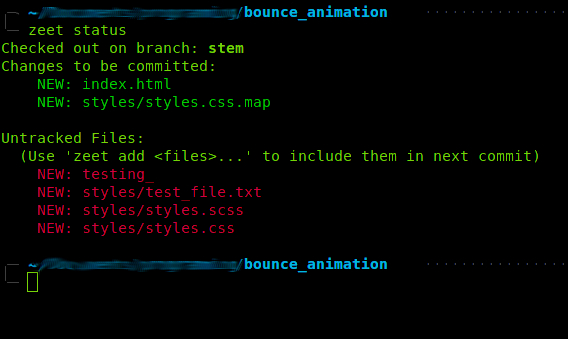 Sample output of
 zeet status -
Commit changes:
zeet commit -m "Commit message"This commits the staged changes with the provided commit message.
-
View commit history:
zeet log
This displays the commit history, showing commit hashes, messages, and timestamps.
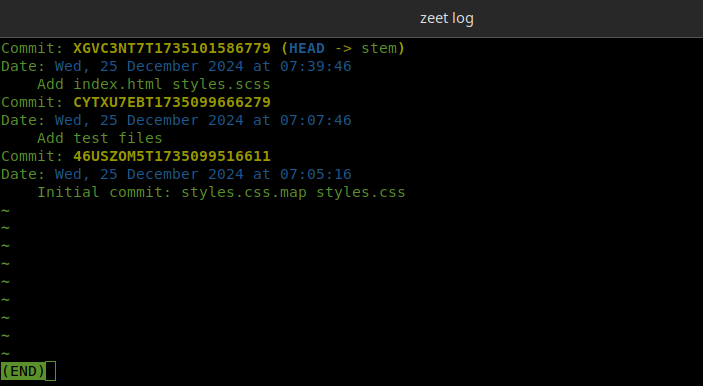 Sample output of
 zeet log -
Create branches:
zeet branch <branch-name>
This creates a new branch.
- Switch branches:
zeet switch <branch-name>
This switches to a created branch.
-
Merge branches:
zeet merge <branch-name>
This merges
<branch-name>into the current checked out branch, with conflict detection.
Fast-forward merge strategy is used when history between the branches is linear. 3-way merge is used otherwise. -
View diffs:
zeet diff <commit-hash>
This shows the differences between working directory and the commit. In place of
<commit-hash>, you can also specify branch or path to a file under repository.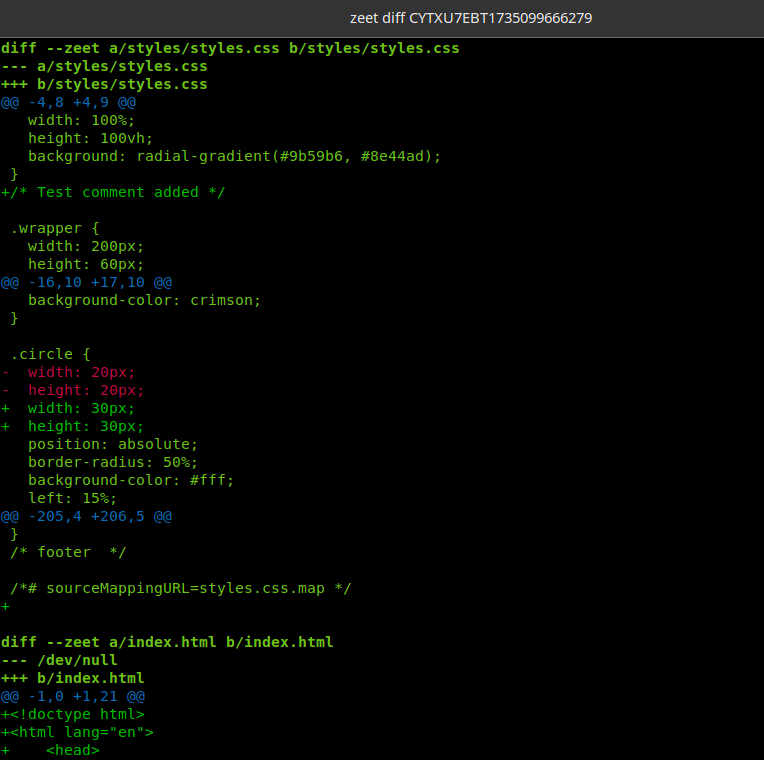 Sample output of
 zeet diffOther than diffing with the working directory, you can also diff between 2 commits, branches or files. For example:
# Compare changes between commits
zeet diff <commit-hash1> <commit-hash2>

# Compare changes between branches
zeet diff <stem> <feature-branch>

# Compare differences of 'file1' in working directory with 'file1' in 'feature-branch'
zeet diff <file1> <feature-branch>

# Compare changes in files in workdir with the last recent commit
zeet diff <file1> <file2>
-
Ignore files: Create a
.zeetignorefile in your repository root and list the files to be ignored.
It accepts the same patterns as with.gitignore.
Feel free to open issues or submit pull requests to contribute to the project. Contributions are welcome!
Distributed under the MIT License. See LICENSE for more information.